
Last updated September 20, 2026
Free on-site gate assessment - hinges, posts, and your LiftMaster or Nice gate operator checked before anything is quoted
The assessment is free and the quote is the invoice.
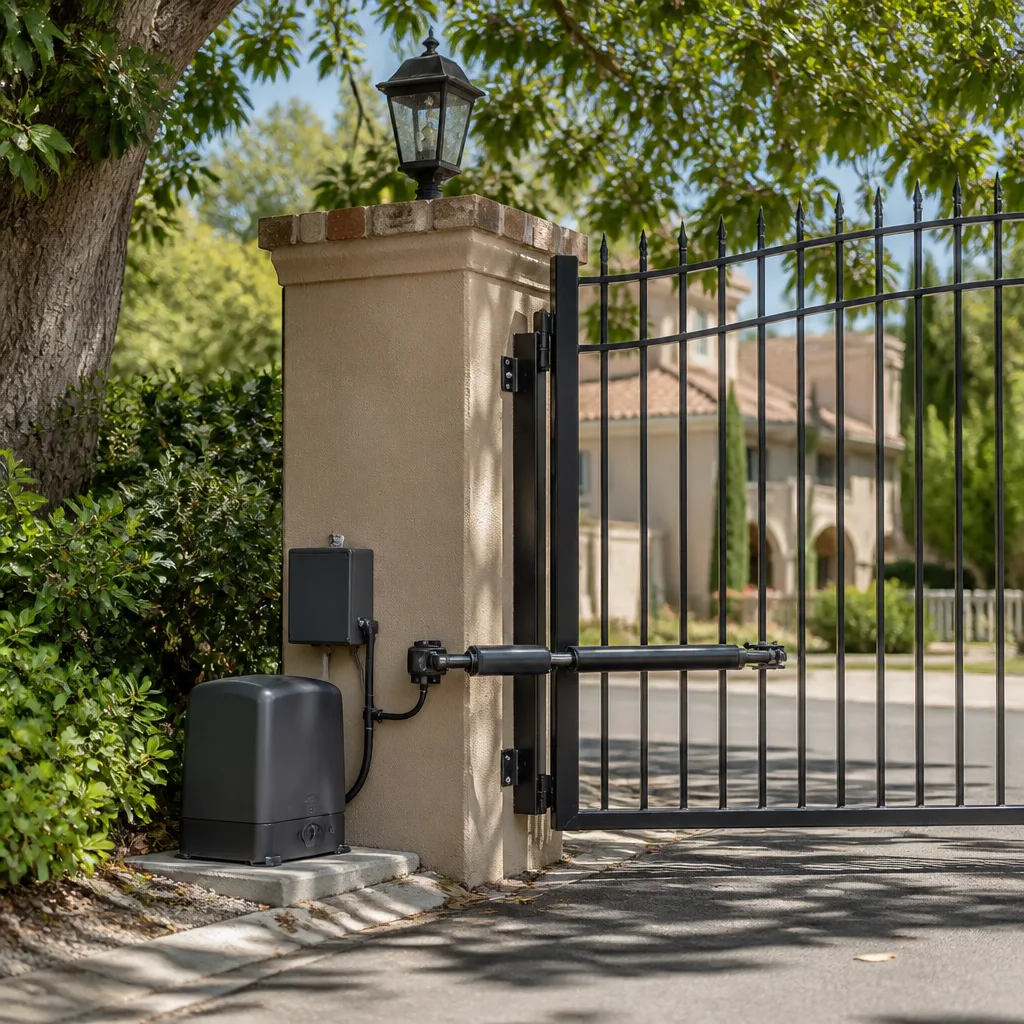
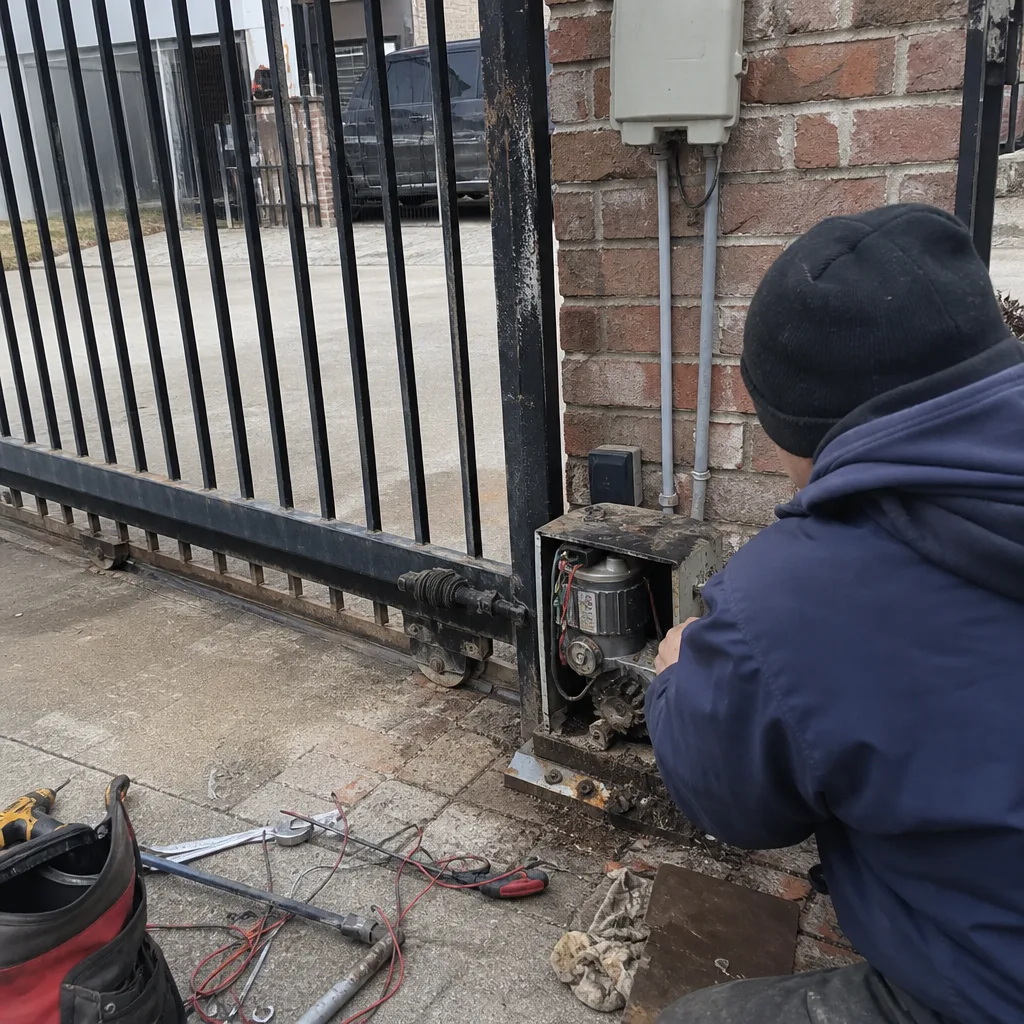 Before
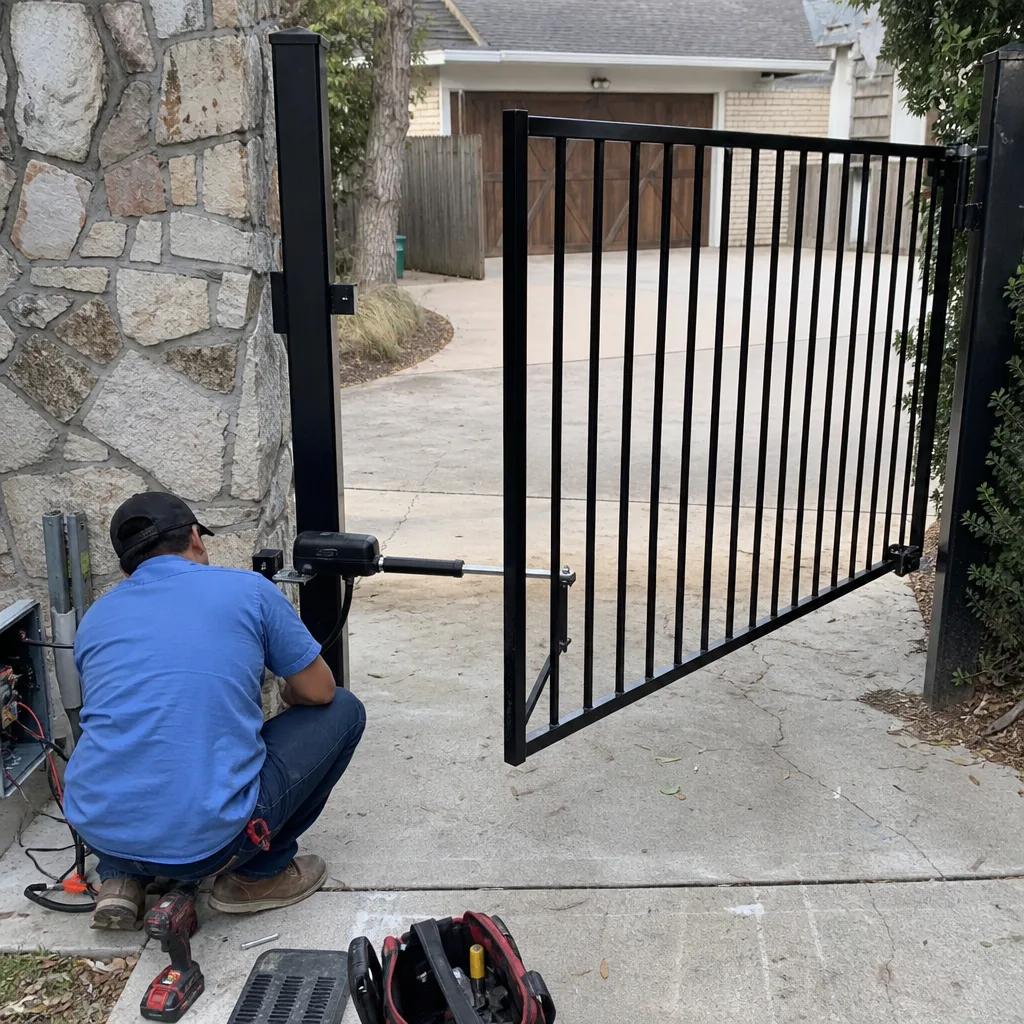 After
After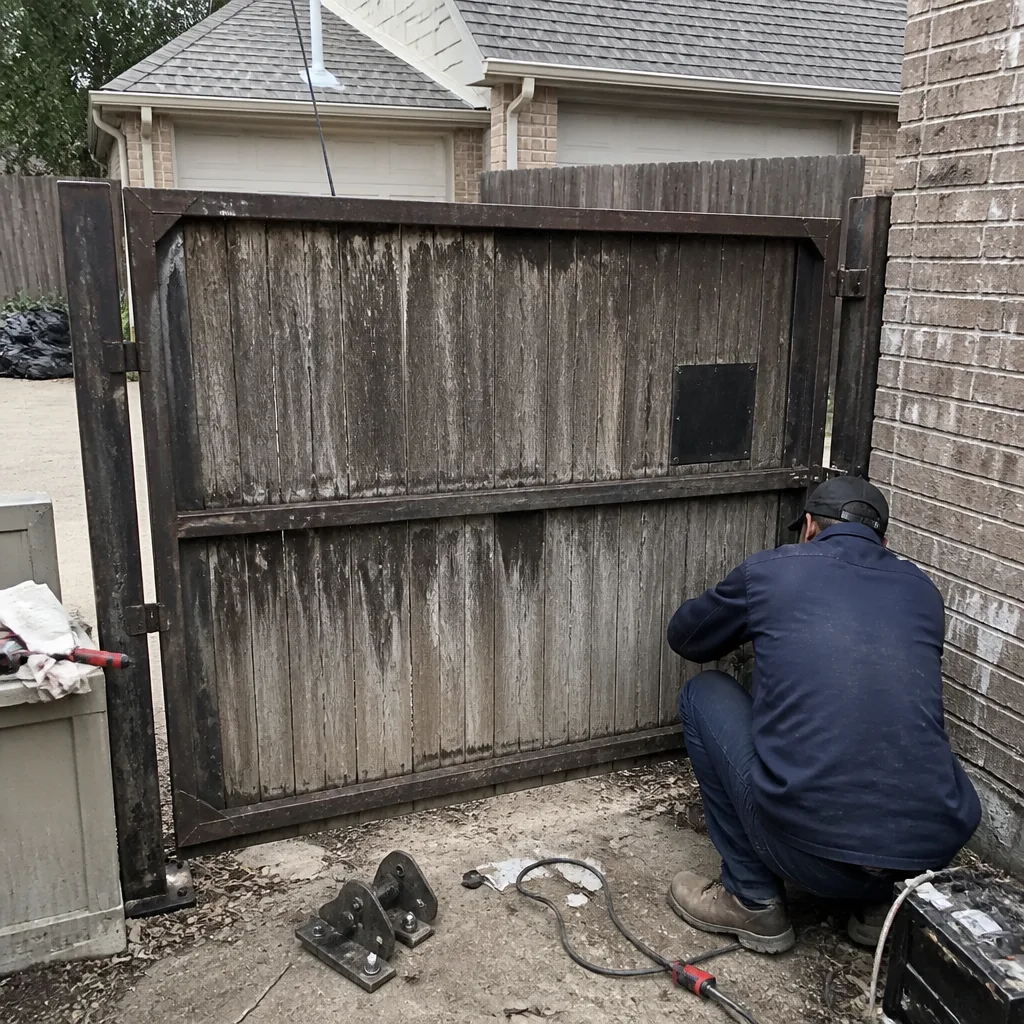 Before
 After
After Before
 After
AfterDIY vs Professional Gate Repair: The Carrollton Homeowner’s Decision Guide
Here’s what surprises most Carrollton homeowners: the gate repair that most confidently looks like a weekend project is often the one that quietly makes the problem worse. A dead battery backup gets replaced, the gate works for three weeks, and then the new battery dies the same way the old one did. What actually failed was the charging circuit inside the operator board, drawing the new battery down every night, and now the homeowner has spent $80 on a part that never addressed the fault. That’s the recurring pattern across Carrollton driveways: the easiest repair is rarely the right repair when the root cause is upstream. This guide-along with our Gate Repair Maintenance Checklist for Carrollton Homeowners-gives you a real decision framework, not a vague list of pros and cons, so you can sort every gate problem into one of two categories before you touch a single tool.
Quick Answer
DIY gate repair in Carrollton is safe and sensible when the repair involves no 120V wiring and does not require documenting limit-switch positions afterward. That means photo-eye realignment, remote programming, keypad batteries, manual-release testing, and basic lubrication are legitimate DIY jobs. Anything that touches the supply circuit, the limit switches, or the logic board should go to a professional, because the cost of a misdiagnosis, in parts plus rediagnosis plus the eventual correct repair, almost always exceeds the original service call.
Table of Contents
- The Two-Variable Decision Framework
- Five Gate Repairs a Careful Carrollton Homeowner Can Do Safely
- The DIY-Adjacent Repairs That Carry Hidden Risk
- The Real Cost of a Misdiagnosed DIY Repair
- How to Hand Off a DIY Repair to a Professional Correctly
- What Carrollton’s Climate Does to Gate Components
- Why Written Documentation Changes the Repair Math
- Common Mistakes to Avoid
- When to Call a Professional
- Frequently Asked Questions
- The Bottom Line
BeforeAfterThe Two-Variable Decision Framework
Forget the vague advice that says “it depends on your skill level.” Skill level matters far less than two specific questions you can answer in under a minute. First: does the repair involve the 120V supply circuit feeding the gate operator? Second: will you need to set or document the limit-switch positions after the work is done? If the answer to both is no, the repair is a legitimate DIY candidate. If the answer to either is yes, the professional route is not just safer, it’s cheaper in the long run. This framework came out of watching Carrollton homeowners succeed and fail across thousands of gate service calls, and it’s built on the actual failure patterns we document every week across the city.
Here’s why those two variables matter so much. The 120V circuit is not the place to learn on the job. Gate operators in Carrollton are typically wired to a dedicated breaker, often a GFCI, and the wiring runs through conduit along or under the driveway. Mis-wiring a replacement operator can fry a brand-new board in seconds, or leave a ground fault that trips unpredictably every time it rains. And limit switches, the tiny internal triggers that tell the motor where to stop, are calibrated to the specific gate’s travel arc. If you don’t record the old positions before you change them, you’re guessing, and a gate that over-travels can bend the arm bracket, strip the gear, or worse, push through a car bumper. Those two questions are the entire decision tree. Everything else sorts out from there.
Five Gate Repairs a Careful Carrollton Homeowner Can Do Safely
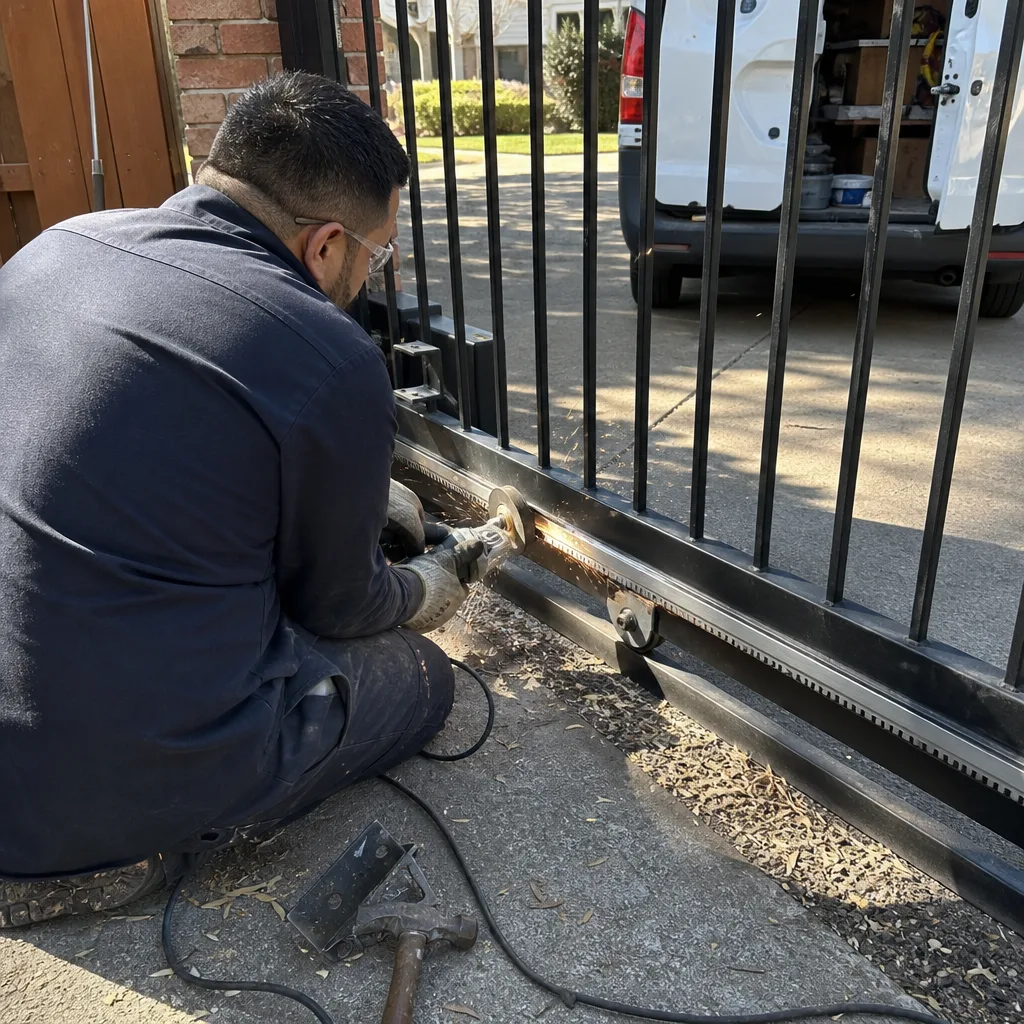
Let’s be precise about what’s genuinely DIY-friendly. These five repairs are common in Carrollton, they do not involve the supply circuit, and they do not change limit-switch positions. Each one, however, should come with a brief written note or a phone photo of what you found and what you changed. That record is what prevents you from paying twice if the repair doesn’t hold.
1. Photo-Eye Alignment
A photo-eye (the infrared beam that stops the gate if something crosses the path) gets knocked out of alignment by foot traffic, lawn equipment, or the soil shifting under the post. The symptom is specific: the gate starts to close, then reverses immediately, or refuses to close at all. On most LiftMaster and Linear operators, the photo-eye has a small LED that glows steadily when the beam is aligned, and blinks when it’s not. The fix is a gentle adjustment of the bracket, twenty seconds at a time, until the LED goes solid. This is a two-screw job. Document it with a photo of the final LED state.
2. Keypad Battery Replacement
Most Carrollton keypads, particularly the FAAC and DoorKing styles, run on a 9V or AA battery that lasts 18 to 36 months. The failure mode is gradual: the code takes multiple presses to register, then stops responding entirely. The replacement takes five minutes, and the battery compartment is usually accessible without removing the keypad from its mount. One caution: do not let the battery contacts corrode inside the housing, because corrosion migrating into the keypad’s main board turns a $6 battery job into a $180 keypad replacement. A photo of the clean battery tray with the new battery installed is adequate documentation.
3. Remote Programming
Programming a replacement remote into a LiftMaster, FAAC, or BFT operator is mostly a button-sequence job, and the sequences are printed in the operator manual. The key detail: you typically have a 30-second window on the operator’s “learn” button before the programming mode times out. Do it with the manual open, and test the remote from inside the car, not standing next to the gate. If you lose the manual, the brand’s support site has the sequence. Write down the date and the number of remotes now enrolled, because that count matters later when a remote goes missing.
4. Manual Release Operation
The manual release is the handle or key that disengages the motor so you can push the gate open by hand. Testing it once a quarter is a genuinely useful DIY habit, and it’s the thing most Carrollton homeowners never do until an outage forces them to. On most swing and slide operators, the release is a red or yellow pull handle or a keyed cylinder. The test is simple: release the operator, roll the gate through its full travel, then re-engage. If the gate fights you or hangs on the track, that’s not a motor problem, it’s a mechanical or alignment problem, and that’s worth documenting with a short video.
5. Basic Lubrication
Carrollton’s heat and occasional dust storms dry out gate hinges, wheels, and chains faster than the national average. A dry hinge forces the motor to work harder, which shortens the operator’s life, and the fix is a silicone-based lubricant, not a petroleum-based one, applied to hinge pins, chain, and wheel bearings. Skip the spring-loaded components if you’re not sure what you’re looking at; a wound torsion spring under tension deserves professional respect. Note the date and the lubricant used. A picture of the hinge pins before and after is enough.
The DIY-Adjacent Repairs That Carry Hidden Risk
These are the jobs that look like they’re in the DIY zone, but aren’t. What makes them risky is not the raw difficulty; it’s that doing them wrong creates a fault that doesn’t show up immediately, or leaves the gate in a state that a future technician can’t diagnose without undoing what you did.
Loop Detector Sensitivity Adjustment
The loop detector senses the metal mass of a car sitting on the loop (the wire buried under the driveway), and adjusts the gate’s open-hold and auto-close timing. Most loop detectors have a dial for sensitivity. The dial is accessible, and adjusting it is technically just a screwdriver turn. The risk: too sensitive, and the gate opens for a bicycle or a shopping cart; not sensitive enough, and it won’t see a small sedan. The factory default is set to a field known to work in most Carrollton conditions, and pulling it off that default without a test car and a timer usually ends with a gate that either doesn’t open or never closes. Leave the dial alone unless you have the detector’s manual and a second person to observe the gate’s behavior.
Limit Switch Setting
The limit switches tell the operator exactly where to stop. On a slide gate that’s a travel point; on a swing gate it’s a degree of arc. Setting them correctly requires the operator manual, a tape measure, and usually several test cycles. Setting them wrong, by even a few degrees, can strain the arm bracket, burn out the motor, or in a worst case, allow the gate to travel past its intended stop and strike a vehicle. This is why documentation matters so much: if you adjust them, write down the exact reading you started from. A professional following you will need that number to restore the correct travel.
Logic Board Replacement
Replacing a board is mechanically simple: unplug the old one, plug in the new one. The disaster happens on the programming side. The replacement board doesn’t know your gate’s travel, dwell time, auto-close delay, loop sensitivity, or photo-eye logic. All of that must be re-taught. If the original board’s settings were never photographed or written down, the board swap wipes the gate’s entire personality. In our Carrollton service area, we’ve replaced boards on BFT, FAAC, and LiftMaster operators and the first thing we do is photograph every DIP switch and read every potentiometer before unplugging anything. That’s the habit that separates a board swap from a board swap followed by a week of debugging.
The Real Cost of a Misdiagnosed DIY Repair
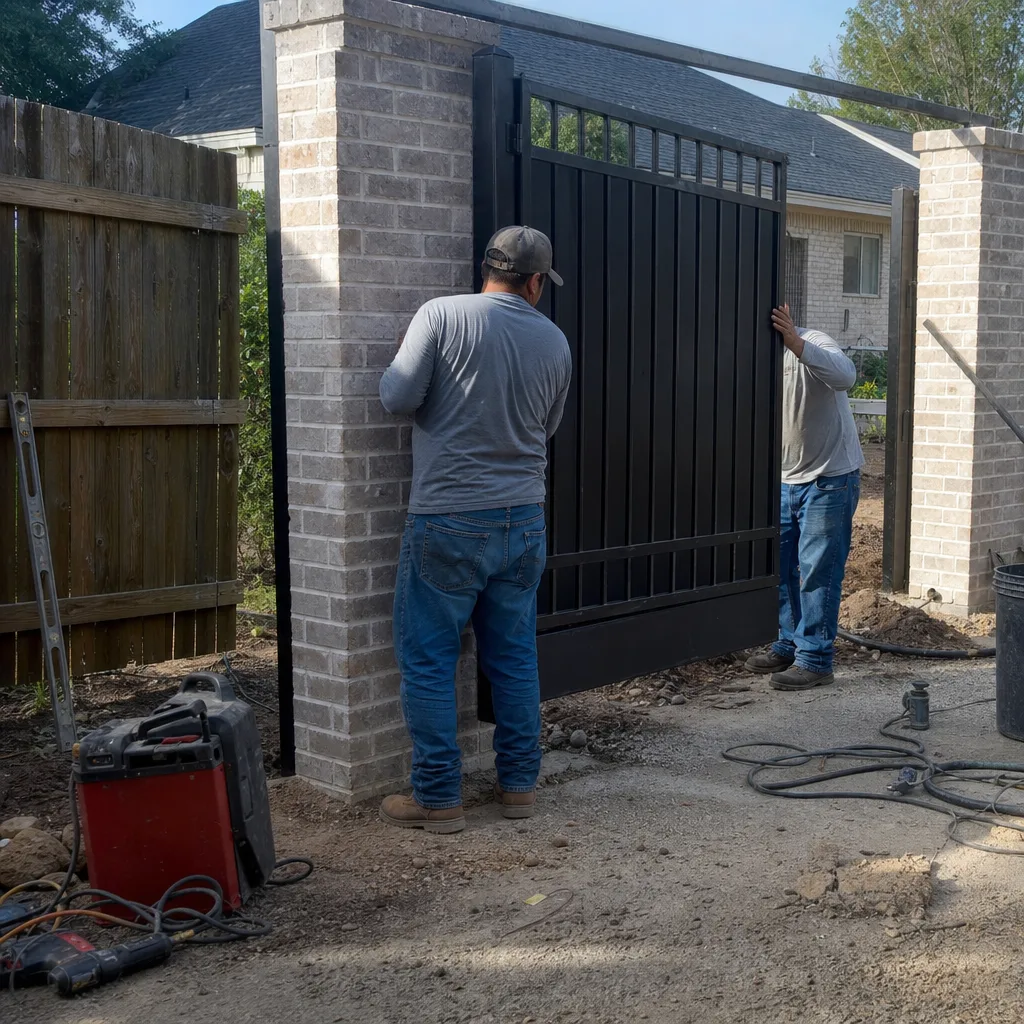
Let’s talk in dollars, because the DIY-versus-professional question is ultimately a financial one, not a philosophical one. For a detailed look at local pricing, see our Gate Repair Cost Breakdown: The Carrollton Homeowner’s Reference for 2026. Here’s the pattern we see across Carrollton: a homeowner diagnoses a “dead battery backup,” spends $60 to $90 on the battery, the gate works for a month, and then the problem returns because the charging circuit was the actual fault. Then he calls us. A service call to diagnose the real problem runs $75 to $125 in this market, and then the board repair or replacement is $200 to $500 depending on the brand. So the total cost of the DIY path, including the wasted battery, is somewhere around $335 to $715. Had he called first, the diagnosis and the correct repair would have run $275 to $625, because the diagnostic fee on a repair we complete is typically rolled into the job. The difference is the cost of the misdiagnosis, and it’s the single most expensive DIY mistake we see.
Here’s the cost table for the most common Carrollton DIY-adjacent repairs:
- Photo-eye alignment: DIY cost $0 (if the bracket is intact), professional cost $110-$170.
- Keypad battery: DIY cost $6-$12, professional cost $90-$140 including the house call.
- Remote programming: DIY cost $0-$30 for the remote, professional cost $85-$130.
- Limit switch reset after a DIY attempt: DIY cost $0-$40 in parts that may now be bent, professional cost $140-$220 including re-documentation of travel.
- Logic board replacement after a DIY attempt wiped the settings: DIY cost $180-$400 for the board, professional cost $320-$600 including reprogramming and documentation.
Notice the pattern: the DIY savings are real on the bottom rungs, and they evaporate the moment the repair touches the settings or the supply circuit. The next section is the hand-off play, because a good hand-off is the difference between a professional who can fix it in an hour and a professional who has to reverse-engineer what you did for two.
How to Hand Off a DIY Repair to a Professional Correctly
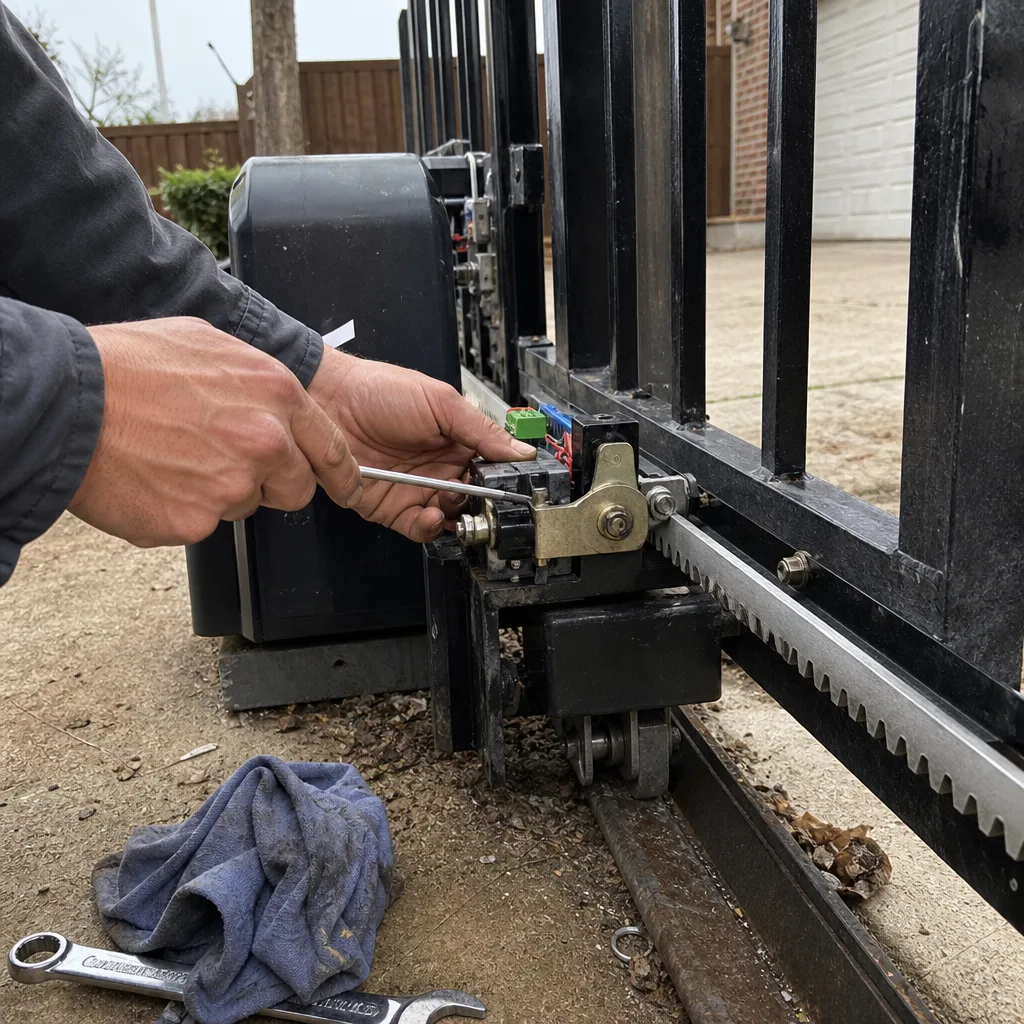
Most of the professional gate repair calls we take in Carrollton start the same way: a homeowner, a partially completed DIY attempt, and no record of what was changed. The hand-off matters, because the first hour of the technician’s time is often spent reconstructing what the gate looked like before the DIY attempt. That reconstruction time is billable, and it is almost entirely avoidable.
- Photograph every component before you touch it. The DIP switch bank, the wire terminals, the limit switch position, the photo-eye bracket angle. A phone photo is sufficient, but it needs to be in focus and taken square-on, not at an angle.
- Write down the symptom in one sentence, not the diagnosis. “Gate closes 12 inches then reverses” is a symptom. “I think the photo-eye is bad” is a diagnosis. Let the professional make the diagnosis.
- Keep the old parts. Even a failed capacitor or a burned board often has a readable part number that identifies the replacement correctly the first time.
- Say what you changed, in order. “I replaced the battery, then I adjusted the photo-eye bracket, then I cycled the breaker” tells the technician where to look first. Random adjustments in random order are the hardest to undo.
- Bring the operator’s manual if you still have it. The model number is printed on the manual cover, and that’s faster than hunting for the data plate under the gate housing.
This hand-off protocol is the same one our Gate Repair in Carrollton technicians use internally, because a documented job is a faster job, and a faster job is a cheaper job. The homeowner who arrives at the phone call with three photos and a one-sentence symptom has already saved themselves the cost of thirty minutes of diagnostic time.
What Carrollton’s Climate Does to Gate Components
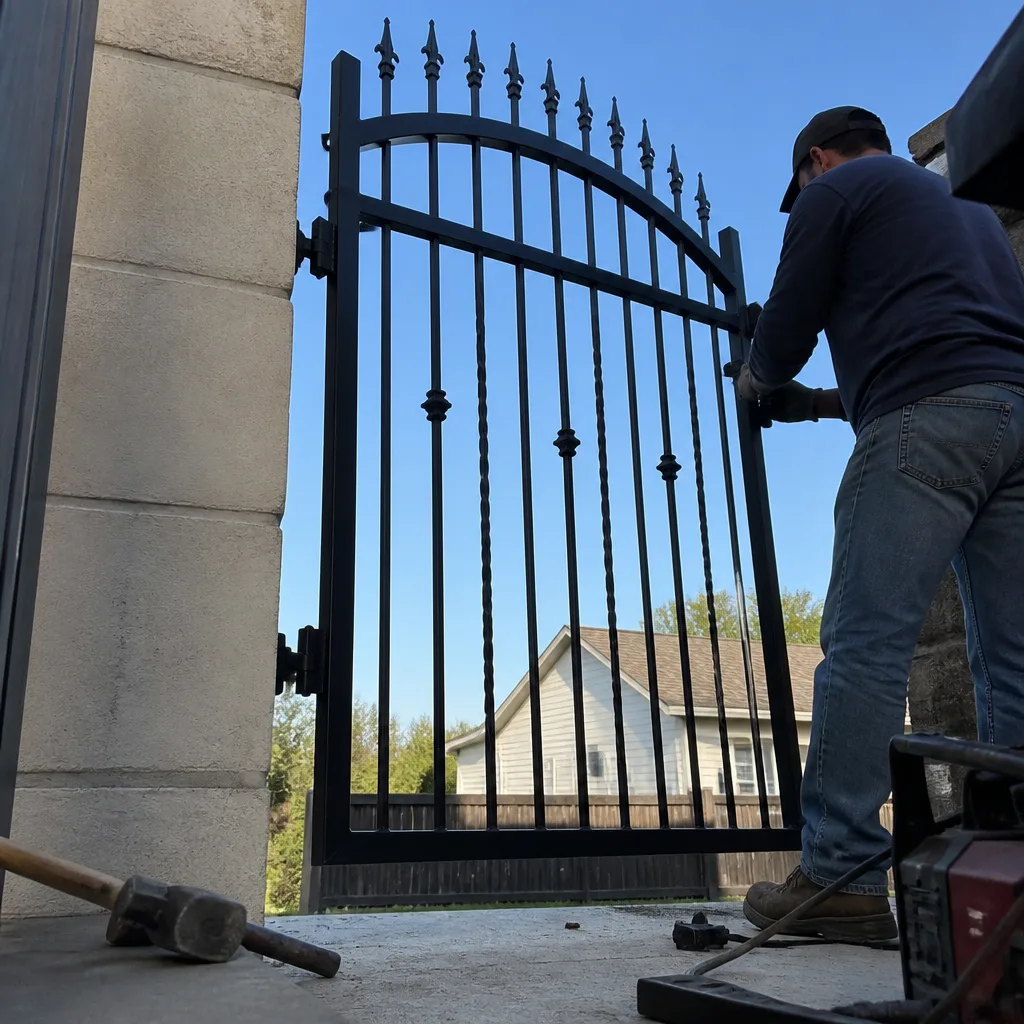
Carrollton doesn’t have a gentle climate for gate hardware. Summer temperatures routinely push past 100 degrees, and the operator housing, typically a metal box mounted to a steel post, becomes an oven. That heat stress shortens the life of electrolytic capacitors on logic boards and accelerates the failure of wiring insulation inside the housing. Then the fall rains come, and the ground around gate posts shifts, which pulls hinges out of alignment and puts a static load on the motor. The freeze-thaw cycle in January and February, mild as it is compared to the Midwest, still expands and contracts the concrete around the post bases enough to produce hairline cracks in the weld points on steel swing gates. None of this is unique to Carrollton, but the combination of heat, drought, and occasional ice makes the Carrollton Gate Repair market heavier on board failures and hinge alignment than the national average. A homeowner who lubricates quarterly and tests the manual release monthly is doing genuine preventive maintenance against the local climate.
Why Written Documentation Changes the Repair Math
Here’s the single most useful idea in this guide, and it comes directly from how Vance Gate Repair Carrollton has operated since Adrian Vance started the shop in 2014 after a decade in commercial access-control work: a gate repair is not complete until the repair is documented. That means a written price before the work starts, a photo log of what was found, what was adjusted, and what was installed, and a written record of the part number. The reason for this standard is financial, not aesthetic. When a professional documents the limit-switch readings, the DIP switch settings, and the photo-eye alignment, the next repair on that gate doesn’t start from zero. The next technician can see exactly what the last one saw. That documentation eliminates the reconstruct-the-crime-scene hour that plagues undocumented repairs, and it means the homeowner never pays twice to rediscover the same problem. The Haven Standard is what Vance calls it: a written price before any tool is picked up, and a documented record before the technician leaves. Clause 1 is “Have it in writing.” Clause 4 is “Evidence on every job.” A homeowner who applies the same standard to their own DIY work, photos and a written note, gets the same downstream benefit: a gate that a stranger can understand without a phone call.
Common Mistakes to Avoid
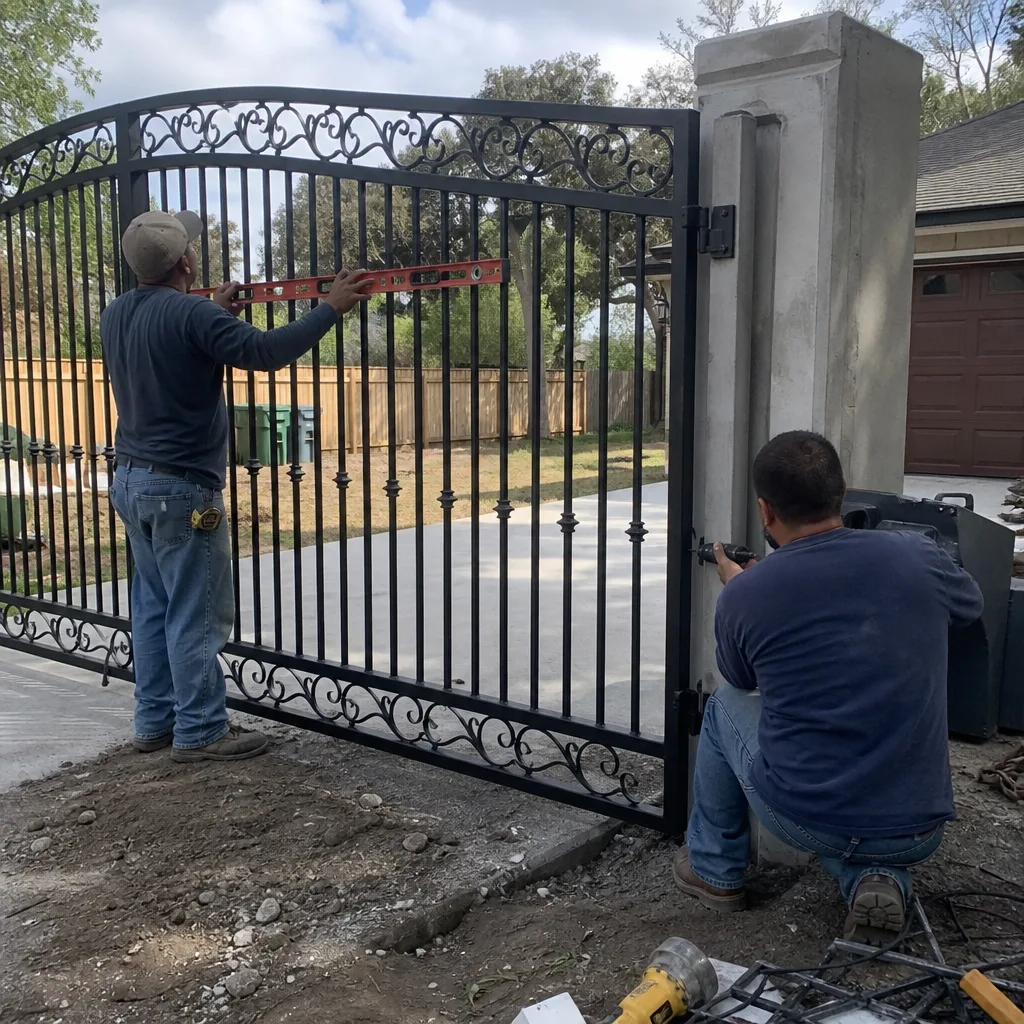
- Replacing the battery without testing the charging circuit. The new battery will die in the same way the old one did, and the homeowner will have spent money on a part that never addressed the fault. Put a multimeter on the charging terminals before buying the battery.
- Adjusting limit switches without recording the original positions. A limit switch moved even a few degrees past travel will bend the arm bracket or strip the gear. Write down the reading, photograph it, and then decide if you want to adjust it.
- Using petroleum-based lubricant on gate components. Petroleum lube attracts Carrollton dust and forms a grinding paste in the hinge. Use a silicone-based lubricant, and wipe off the excess.
- Power-cycling the breaker to clear a fault without understanding the fault. If the breaker tripped, something caused it. Cycling it repeatedly can damage the operator board and leave a ground fault that trips unpredictably. One reset, then investigate.
- Testing a photo-eye adjustment with the gate under load. If the gate has a vehicle in the path during the test, a misaligned eye can let the gate close on the car. Test with the gate in manual mode or with no obstruction in the path.
- Assuming all gate brands program the same way. A LiftMaster remote sequence is not the FAAC remote sequence is not the BFT remote sequence. Use the manual for the specific brand, and don’t blind copy a YouTube tutorial for a different operator.
- Not documenting the hand-off. The homeowner who calls a professional without photos, without the old parts, and without a written symptom has already spent thirty minutes of billable time on reconstruction. Document it before you pick up the phone.
When to Call a Professional
Call a professional when the repair touches the 120V supply circuit, when it requires setting or documenting limit-switch positions, or when the gate has started behaving intermittently and you can’t reproduce the fault in five minutes. Intermittent faults are the most expensive DIY traps, because the misdiagnosis runs in circles. Vance Gate Repair Carrollton offers free estimates in Carrollton, and a written price is delivered before any work begins. Call (817) 778-4585 for a documented, evidence-first assessment.
Frequently Asked Questions
Most gate repairs in Carrollton run between $110 and $350, with motor and operator replacements running $400 to $750 depending on the brand and whether the arm bracket is intact. Photo-eye alignment, remote programming, and keypad battery swaps sit at the low end, while logic board replacements and limit switch resets fall in the middle. Gate Motor & Opener in Carrollton service is quoted as a written, flat price before work starts. Call (817) 778-4585 for an exact quote, the estimate is free.
You can repair a Carrollton gate opener yourself if the repair does not involve the 120V supply circuit and does not require limit-switch documentation. For more guides & resources, explore our blog. That leaves remote programming, keypad battery replacement, and photo-eye alignment as DIY jobs. Anything past that, especially a board swap or a limit switch adjustment, is a professional job because the misdiagnosis cost almost always exceeds the initial service call.
A well-maintained gate opener in Carrollton lasts 7 to 12 years, with the heat stress on the logic board capacitors being the primary local failure driver. Operators mounted in full afternoon sun tend to fail earlier than those shaded by a fence or a tree. The annual maintenance habit that extends the life the most is lubrication of the hinge and wheel points, which reduces the current draw on the motor and the board.
The most common DIY gate repair mistake in Carrollton is replacing a dead battery backup without testing the charging circuit that caused the battery to fail prematurely. The new battery dies the same way the old one did, and the homeowner has now spent money on a part that never addressed the actual fault. A multimeter reading on the charging terminals before the battery purchase would have prevented it.
Most gate repairs in Carrollton, including motor replacement, board replacement, and hinge service, do not require a permit. A new gate installation, particularly one that involves new electrical wiring or a new operator post, may require an electrical permit through the City of Carrollton. If you’re unsure whether your repair crosses into installation territory, Gate Installation in Carrollton guidance is available, and a written quote can clarify the scope before you commit to anything.
Most professional gate repair calls in Carrollton are completed the same day, with the typical service window running 2 to 4 hours from arrival to documented completion. The repair speed depends on the part’s availability; common parts like photo-eyes, keypads, and hinge brackets are usually stocked on the truck, while logic boards for less common brands may require a day or two. Vance Gate Repair Carrollton dispatches a named technician with a photo and license number before arrival, and the written price is in your hand before any work begins.
The Bottom Line
The DIY-versus-professional question has a real answer in Carrollton, and it’s built on two variables: presence of 120V wiring and the need for limit-switch documentation. No on either count, and you can safely handle the photo-eye, keypad, remote, manual-release, and lubrication jobs. Yes on either count, and the professional route is cheaper once you account for the misdiagnosis cost that follows a DIY attempt on a board, a switch, or a supply circuit. The pattern applies to every gate repair in this city, and it holds for every brand from LiftMaster to FAAC to BFT to Linear. If you want the long version, the guide above is the full framework. If you want a written price on your specific gate, call Vance Gate Repair Carrollton at (817) 778-4585, and you’ll have it in writing before any tool gets picked up.
Written by Adrian Vance, Owner at Vance Gate Repair Carrollton, serving Carrollton since 2014. Vance Gate Repair Carrollton home